
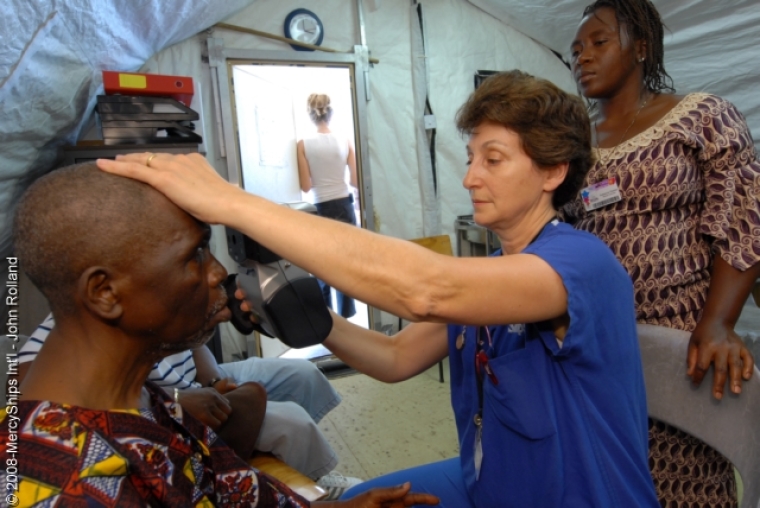
But for Glen and Carmen Ryan of Shoalhaven Heads, on the NSW South Coast, three weeks on the world's largest private hospital ship docked for ten months in what is regarded as one of the world's poorest nations was described as a privilege to be there.
Carmen, with a background in ophthalmic and geriatric nursing, and Glen, a school teacher with skills in computer management, heard about the work being done by volunteers serving with Mercy Ships and decided to offer themselves for short-term service. "We heard about it from another local Paula Smith, who spent four weeks onboard the Africa Mercy, and who now serves with her husband as representatives for the charity in the region," Glen says.
"Carmen wanted for some time to use her nursing skills in missionary work and news of Mercy Ships was the perfect solution. We have both been involved in some missionary work in Papua New Guinea and Jamaica in the past. To prepare better for what was expected of Carmen as a member of the eye surgery team during the ship's current assignment to Liberia, she did some extra training at the Sydney Eye Hospital." Glen did extra work at the local gym to ensure he could cope with the many staircases onboard the ship, which accommodates a crew of 450.
"Most of our friends were very encouraging about our plans to go. Non-Christian friends thought we were great people for doing such a thing, but of course as Christians we believed it was just something we were able to do. Mercy Ships volunteers serve on the principle of following the example of Jesus to bring hope and healing to the world's forgotten poor. And that's all we felt we were trying to do."
While Carmen was busy using her nursing skills, Glen used his computer expertise to help keep the ship's computer system functioning smoothly. He says, "It was pretty mundane work that the long-term volunteers onboard simply don't get the time to do."
Like so many who visit Liberia, struggling to recover from years of civil war and poverty, Carmen and Glen described the experience as something they had not witnessed in other developing nations they had visited. "You have to be there to get any real perspective of the effects of the war on the lives of the people and the desperate conditions they survive in. Health facilities are almost non-existent, and there is a huge need for upgrading the country's infrastructure of power supply, water, waste management, sewage and roads. It makes us more aware of the way we take for granted the things we enjoy in Australia. In a way it makes us feel very selfish. We have so much. They have nothing."
The couple described the work of Mercy Ships, providing a range of free medical and community development services to the poor, as something of a privilege to be a part of, even for the short time of their trip. They will consider returning in the future. "It amazed us to see so many people from so many countries of the world coming together with so many diverse gifts and talents, and using them with such dedication and professionalism. They did it simply to demonstrate God's love and compassion."
Mercy Ships is an international Christian charity that has operated hospital ships in developing nations since 1978. Mercy Ships offers a range of health and community development services free of charge. Highly skilled surgeons on board the ships perform thousands of operations each year to correct disability, disfigurement and blindness. Medical and dental teams travel the countries and establish clinics to provide vaccination programs, dental treatment and basic health care for those with no access to these facilities. Local community health workers receive training in hygiene, nutrition and disease prevention.
Mercy Ships builds hospitals, clinics, training facilities and basic housing where none exist. Agricultural projects help replenish livestock in war-torn areas and boost food production. Working in partnership with local people, Mercy Ships empowers communities to help themselves. The result is a way out of poverty.
The emphasis is on the needs of the world's poorest nations in West Africa, where the hospital ship Africa Mercy provides the platform for services extending up to ten months at a time. A permanent land-based program operates in Sierra Leone, while teams also work in several nations of Central America and the Caribbean. Mercy Ships has 14 support offices around the world, including the Australian office at Caloundra, on the Queensland Sunshine Coast.
On the web: www.mercyships.org.au