
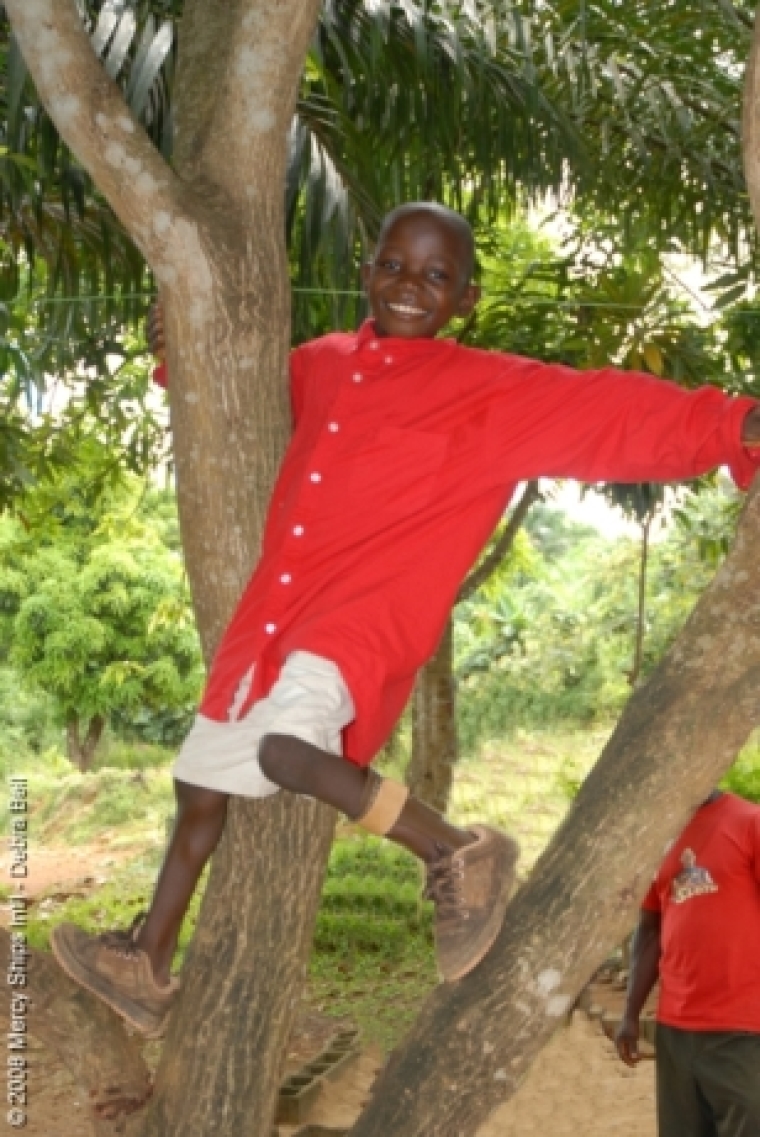
|PIC1|Benedict Menkoah probably doesn't know that on December 3 the world promotes issues surrounding disability, that it's the 60th anniversary of the UN's Universal Declaration of Human Rights, or that his story is an encouragement to others around the world. What he does know is that now, thanks to several free surgeries onboard a Mercy Ship, he can run with his feet facing forward.
"I am able to walk now," Benedict says. "I want to go to school. I can play football. I can play with friends." He is also accepted by his extended family for the first time in many years, allowed back home because he is now "able." As he scurries up a tree to show how easy it is to climb, Benedict adds confidently, "I want to be a doctor." With no money to send his son to school, his father can only hope.
As one of 16 children growing up in rural Liberia, Benedict's bi-lateral clubbed feet were a disfigurement and burden that some family members could not bear. Only an older sister who was a teacher and saw how Benedict himself refused to surrender to his handicap, continued to hope that her little brother's disability would not define the rest of his life. She took care of him, along with her own son and three of Benedict's siblings.
In 2007, and again in May this year, his sister Beatrice brought Benedict to the Mercy Ship in Monrovia for two successive operations on his right foot and then his left foot. Since leaving the ship, he has attended regular physical therapy appointments at a hospital in Monrovia. Ironically, Benedict's last physio appointment is scheduled for December 13th, the day the Mercy Ship leaves Liberia at the conclusion of a ten-month assignment.
According to the World Health Organisation 80 percent of all disabled people live in developing countries. The WHO estimates there are about 600 million disabled people around the world, or about 10 percent of the population. "Poverty and disability are so closely related," says Dr. Gary Parker, chief surgeon and 21-year veteran volunteer onboard the Africa Mercy. "But the additional social stigma added to the inaccessibility of health care further complicates the difficulties that disabled people face. Every person we can help will also help change attitudes in their community towards the stigma of disability."
Originally invited by the UN in 2005 to assist in the health care vacuum created by the civil war in Liberia, Mercy Ships surgeons have seen much change in the country since the end of the war and free elections. Over the past 30 years, Mercy Ships has worked in more than 70 countries providing services valued at more than $670 million, directly impacting more than 1.9 million people. More than 850 crew worldwide representing more than 30 nations, are joined each year by thousands of short-term volunteers. Professionals including surgeons, dentists, nurses, community developers, teachers, cooks, seamen, engineers, and agriculturalists donate their time and skills to the effort. www.mercyships.org