
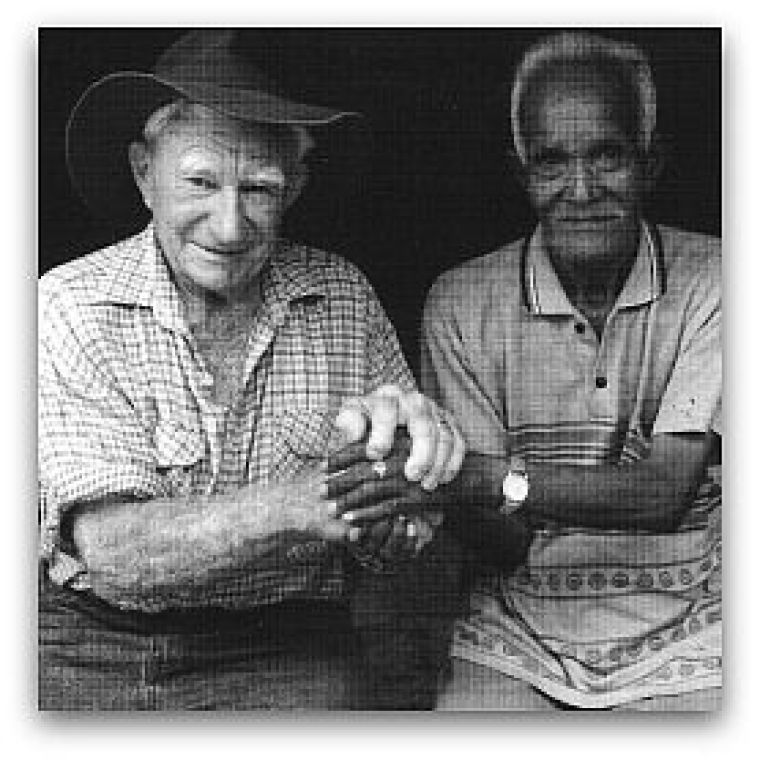
While more than 20,000 Australian soldiers were captured by the Japanese on islands to the north of Australia, the unit in Timor known as the 2/2nd Australian Independent Company fought a successful guerrilla war in the mountains.
As the Oscar-winning filmmaker Damien Parer noted at the time, the men in this unit were 'unique in that they remained an organised fighting body all through the lightning Jap successes ... These lads are writing an epic of guerrilla warfare.'
Kenneally took part in two of the defining actions of this campaign during his year of service there.
On the night of 14 May 1942 he was one of 13 men who mounted a raid into the heart of the Japanese headquarters in the capital, Dili. The men shot up the barracks and escaped without suffering any casualties. Kenneally, and his platoon commander Geoff Laidlaw, were the last to come of the town that night.
One week later, when the Japanese came looking for the raiders, Kenneally was there again. He was one of six men who ambushed about 100 Japanese soldiers near the village of Remexio, in the hills above Dili.
The Australians were armed with 303 rifles and one sub-machine gun, but they used the terrain of Timor to their advantage and took more than 20 enemy casualties. One of those killed in this attack was a senior Japanese officer who had been brought to Timor to drive out the bandits in mountains.
All of this would not have been possible without the support of the local population. Kenneally and other veterans said they would not have lasted a week had the Timorese not protected them.
The Timorese paid dearly for their support, with an estimated 40–60,000 perishing in the conflict. As Kenneally often said, all they got from supporting us was misery.
Kenneally served with the 2/2 for the rest of the war and saw action in New Guinea. He also returned to PNG after the war and at 75 climbed Mt Wilhelm, the country's highest mountain.
John Patrick Kenneally, always known as Paddy, who has died aged 93, was born in Youghal, County Cork, Ireland, son of Michael Kenneally and his wife Mary Ellen Morrissey. The family migrated to Australia in 1927.
By virtue of his energy and longevity, Paddy Kenneally probably did more than any other person to remind Australia of its debt to the Timorese, especially after the Whitlam Government gave Indonesia the green light to invade the territory in 1975.
During the occupation Kenneally visited the territory four times, starting in 1990, when he was 76, and travelled extensively around the hills where he had fought. He returned three more times after the ballot on self determination.
Kenneally reported back to East Timor activists in Australia, and to the veterans who remained involved in the country, through aid projects and their newsletter, the 2/2 Commando Courier.
While he was a Labor man through and through, Kenneally had little time for Gough Whitlam because of his support for Indonesia's invasion.
Opening a photo exhibition on East Timor in Parliament House, Canberra in 1996 in the presence of several Labor luminaries, Kenneally lambasted Whitlam for his treatment of the Timorese. When in 2005 East Timor was struggling to get a fair deal in negotiations over Timor Sea oil, Kenneally rallied his mates to fight one last time for East Timor.
Appearing in national television ads on the eve of ANZAC Day, Kenneally and five other veterans called on the Howard Government to give the impoverished new nation a fair go. Kenneally told Prime Minister John Howard in his appearance: 'I'd rather that you did not come to my ANZAC Day parade.'
The following day, the Australian Government capitulated, offering East Timor a 50 per cent share of the disputed Greater Sunrise field.
Right to the end, Kenneally's love for the Timorese and the country where he fought remained fervent. Last year, he returned there with two sons and a grandson, where he attended the ANZAC Day service at the war memorial built by the 2/2 veterans overlooking Dili.
Paddy Kenneally is survived by his wife of 57 years, Nora (nee Kelly), their children Gerald, Helen, Michael and Sean, and seven grandchildren.
Source: Eureka Street