
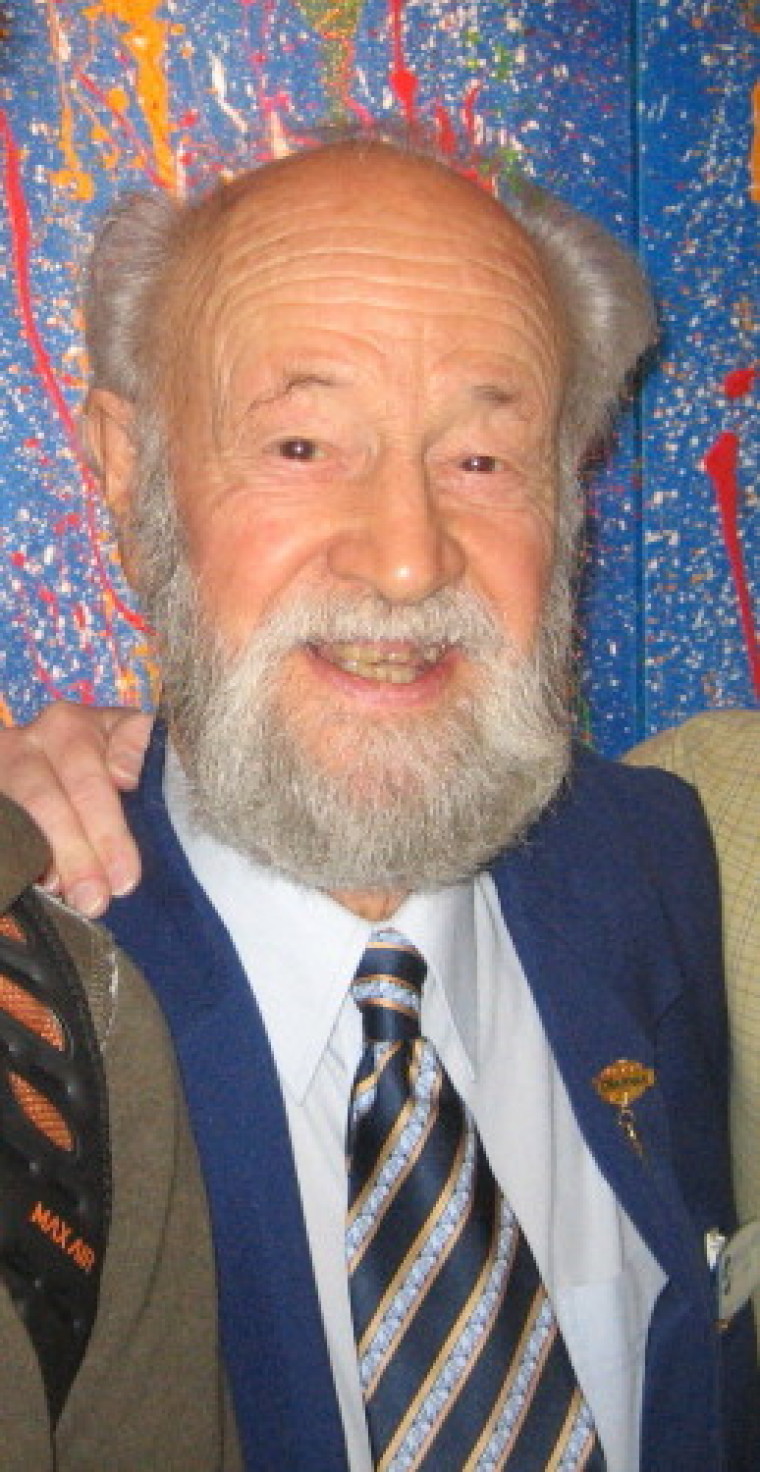
Now, 33 years after that Gold Medal victory the role of the unsung hero of that New Zealand 'Gold Medal' victory was revealed at a funeral service for the late Douglas White.
Mark Tronson and Mr Douglas Edward White, 87, had been meeting regularly for lunch and for theological and philosophical discussions since Mark and his wife, Delma, had moved to Tweed Heads at the end of 2005. Douglas White, a WW II veteran, had also earned a Masters of English and served for many years as the Chairman of the South Tweed Sports Club.
On one occasion Mark Tronson had visiting theology students from Sydney's Baptist Theological College (Morling Lodge) join Douglas White for an hour's discussion.
Mark Tronson is a Baptist minister whose ministry Well-Being Australia focuses on respite and pastoring for elite athletes. 'Basil Sellers Tweed' is a respite facility he has set up for Australian Institute of Sport athletes based in SE Queensland, and is a replication of the Basil Sellers Moruya facility that the Tronson's had coordinated for 14 years before relocating to the NSW north coast.
In early 2006 Mark Tronson addressed the Tweed Heads Chamber of Commerce on his ministry and Mr Douglas White called him aside explaining that for many years in New Zealand, he served as a Master in University Colleges in Dunedin.
He witnessed the stress that many of the brightest and best young men experienced, resulting in some taking their own lives. Mr Douglas White had the highest respect for Mark Tronson's elite athlete respite ministry.
As a result of their friendship, Mark was invited by the family of the late Douglas White, to conduct the funeral, where he told this story of the theology students to the congregation: some saw Douglas White as Methuselah (because he was so old), Zechariah (because he looked and spoke like a prophet) and Catweazle (because he spoke in 11th century imagery).
Mr White's son, Geoffrey White, who came over from Dunedin, New Zealand, for his father's funeral, spoke of his father's astonishing ability to bring the best out of people, and this was most obvious when he coached sporting teams.
Geoffrey White said that he discovered the technique his father employed was intellectualising the problem area of the athlete. At that point he developed an idea for the athlete to employ with a simple redirection of play. In relation to wider strategy, the same applied. It was revolutionary. He commanded extremely high personal respect for his understanding of 'the inner athlete'.
The university teams that he coached won countless rugby and hockey championships within New Zealand, and he decorated his 'den' with framed photographs representing all these rewards.
After his son Geoffrey White spoke, Mark Tronson said he re-read the 10 page article he wrote in 'World Hockey' on that New Zealand 1976 Montreal Olympic Gold Medal, and realised that it spoke of the techniques that this New Zealand team had developed to counter the new European style of 'power hockey'.
The Dutch, West Germans, Spain, Great Britain and Belgium had reinvented hockey to put an end to the stranglehold the sub-continent nations (India and Pakistan) had on the sport.
Rather than competing with stick skills, the Europeans developed soccer tactics, by pushing the ball back to retain control. Goals came from penalty corner set plays with specialists corner strikers. West Germany won the 1972 Olympic Gold Medal, Holland the 1974 World Cup Gold Medal.
New Zealand for the 1976 Montreal Olympics came up with a strategy to counter this new European 'power hockey'. As a result, New Zealand drew with West Germany 1-1, beat Belgium 2-1, then Spain 1-0 and in the semi-final, defeated Holland 2-1, before putting paid to Australia 1-0 for the Gold Medal.
Until this international tournament New Zealand had never looked like making a semi-final. Thirty-three years later, Geoffrey White gave the secret away.
Six of the players, that is more than half the team, were from the Otago University hockey team that was coached by his father Douglas White.
When they returned to Dunedin, it was revealed that the techniques Douglas White had suggested be employed to beat this new European style of play, had in effect been adopted in large measure in Montreal by coach Ross Gillespie.
In discussing this with Geoffrey White, the 'secret' Douglas White employed required the athlete to be super fit as it hinged on consistently pushing the play to the right side of the field, in effect attempting to box in their opponents, as they were used to confining themselves to their conventional positions.
It was a philosophical plan to upset the European's set play and gave enough scope for the New Zealanders to snatch opportunities to score for themselves.
The Gold medal outcome was undeniably a result of Douglas White's careful intellectual analysis on how the counter European set play patterns.