
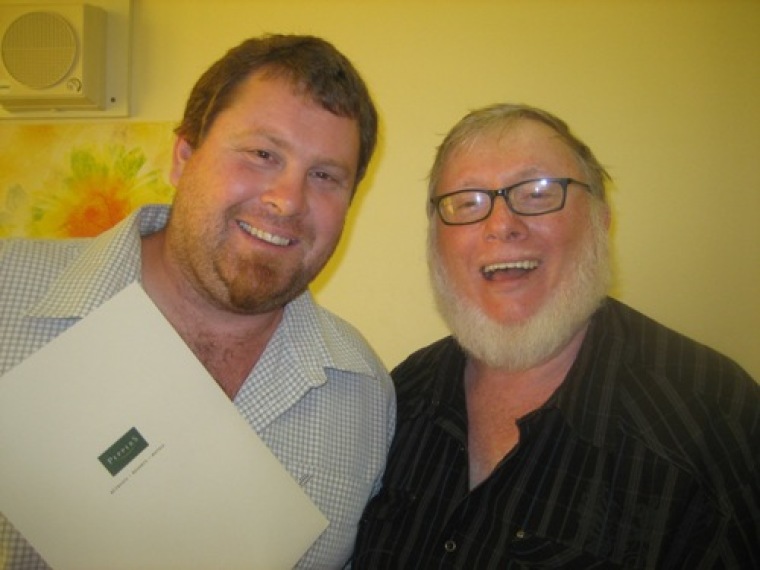
"I sense that people are returning to a philosophy of realising the importance of the corner-shop church, opposing a trend in recent years to move into large mega-church enterprisers," M V Tronson suggested.
The corner-shop arises from the necessity for people to trade goods, in any society where there is no other transport than one's own legs. In Australia, the tradition is more modern than some older societies such as those described in the Old Testament and in the histories of peoples of all continents.
Our Australian roots only go back a couple of hundred years, to those early settlement years where there was no alternative to buy day-to-day necessities in suburban and regional areas unless an entire day was given to a trip into town, which was usually a monthly chore.
"From well before WWII my wife's grandparents ran a corner-shop in a small community north of Taree on the mid north coast of New South Wales. The corner shop provided surprisingly almost anything and if it wasn't in stock, they could get it in," M V Tronson explained.
"Also, my own great grandfather started a general store on the goldfields near Gympie, as he realised the miners needed everyday items, as well as tools and clothes for their new profession, and they didn't have the means to travel to larger towns."
Since the whole town was usually built around a 'main road', often centred around a railway station and shops and hotels, the local denominational churches were obviously built within walking distance of the corner shop in a small community.
As larger communities developed, and transport improved to horse-and-buggy to motor car, some denominations chose to select more attractive and larger blocks on which to build their churches and graveyards. However, the community still travelled to these central places on a Sunday, and still regarded their own congregations in the same way as the 'corner shop' in the town.
During the building boom of the post-WWII situation, some corner-shop churches began developing sports as a means of ministry. Canberra Baptist Church was set less than one block from the Kingston shops and as young families moved into that congregation, junior field hockey and netball teams were established.
"This well tried methodology has proved to be effective in the past, in attracting and retaining young people within the community, into the congregation," Mark Tronson reminisced. "It is the re-thinking of this process that Well-Being Australia is encouraging within established corner-shop churches."
The final Well-Being Australia Country Town Tour in 2008 to north Queensland was specifically directed to set the agenda for establishing sports-oriented programs in 2009.
"There comes a time where the essence of the ministry becomes imparting knowledge rather than hands-on; where younger hands can take on such visions and develop them for the next generation. Each fresh generation must gain their own vision for ministry," M V Tronson proposed.
To this end as from 1 January 2009, Well-Being Australia is calling upon regional and rural churches to call WBA for a visit so as to share what can be developed for the corner-shop congregation and how effective sports ministry can be in that setting.