
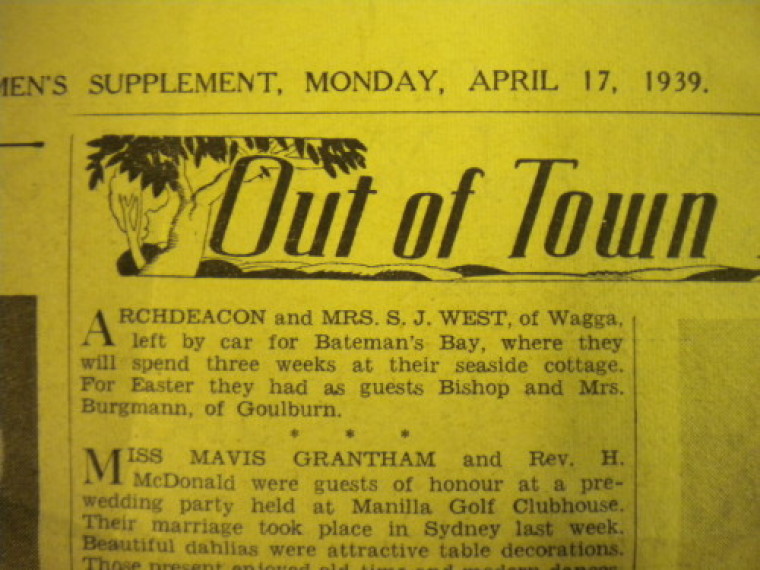
The first item in this column read: "Archdeacon and Mrs S J West, of Wagga, left by car for Batemans Bay, where they will spend three weeks at their seaside cottage. For Easter they had as guests Bishop and Mrs Burgmann of Goulburn."
My late mother who died in 1995 aged 75 years had a wide range of cuttings secured safely in this chest dated from 1935-39.
From 1939 she was in the Land Army and deployed to the Tumut-Batlow area and the Riverina, therefore we have little of this later period apart from a number of Land Army magazines and documentation. We even have her Land Army official blazer and her Land Army Badge.
It was fascinating therefore to ponder on the reasons why my mother would have kept this particular snippet from the Sydney Morning Herald.
Certainly she was a committed Christian, and was involved in a wide variety of Christian youth activities centred around Central Baptist Church in George Street, Sydney and was busy with mission promotion.
My mother was forthright with considered opinions, and was not shy to explain her ideas to people. Although she was only 19 in 1939, her Land Army years illustrated her leadership qualities when she was chosen to give a speech on behalf of the girls at the end of the war.
Therefore, we can assume that my mother must have known the clergy mentioned in this column or knew someone who knew them and their travels.
We can glean from this news item that Mrs West most likely was widely known in the Sydney community, and therefore the fact that she could holiday at their seaside cottage was of 'social interest'. Moreover, they had previously hosted a Bishop and his wife.
Today, I could not imagine such an item appearing in the Sydney Morning Herald or any of its supplements.
The item following is also interesting: "Miss Mavis Grantham and Rev. H McDonald were guests of honour at a pre-wedding party ….. Their marriage took place in Sydney last week ..."
The Church society personality, Mavis Grantham, was marrying a Reverend gentleman.
I think we can make some broad assumptions, based on what we know of how social norms and customs have changed since World War II. Sydney was a very different city in 1939. It was much smaller, people tended to know each other in circles of interest, and also many attended church and therefore the clergy and their wives were story worthy.
Ministers of religion were more educated than many others and took a respectable position as a leader in the community. Those educated in the professions such as ministers, teachers, doctors, lawyers and politicians were shown honour in a way that we do not show today, where education is more universal and we regard ourselves as equally as well-informed about general matters in our society as these specialists.
Moreover, individuals can travel more easily to more distant suburbs to interact with people of similar interest and also recent statistics quoted on the ABC program 'The Spirit of Things' indicate that only about 55% of Australians state that they believe in God (and this would include those of some religions other than Christianity); so for reasons such as these the clergy are no longer the mainstay of many people's immediate community, and are often not known in the wider social circles of a city like Sydney.
www.abc.net.au/rn/spiritofthings/stories/2010/3074192.htm
As celebrities are admired today, with their 'comings and goings' so too there was an era in the 1930s when media savvy clergy and their wives were recognised. It was the Miss Marple era where many a young Christian woman dreamed of marrying a clergyman and hosting the Bishop and his wife for afternoon tea in the garden.